
Fiber analysis is one of the most important routine tests in feed and forage laboratories.
Parameters such as:
- ADF (Acid Detergent Fiber)
- NDF (Neutral Detergent Fiber)
are widely used to evaluate:
- Feed digestibility
- Animal intake potential
- Nutritional quality
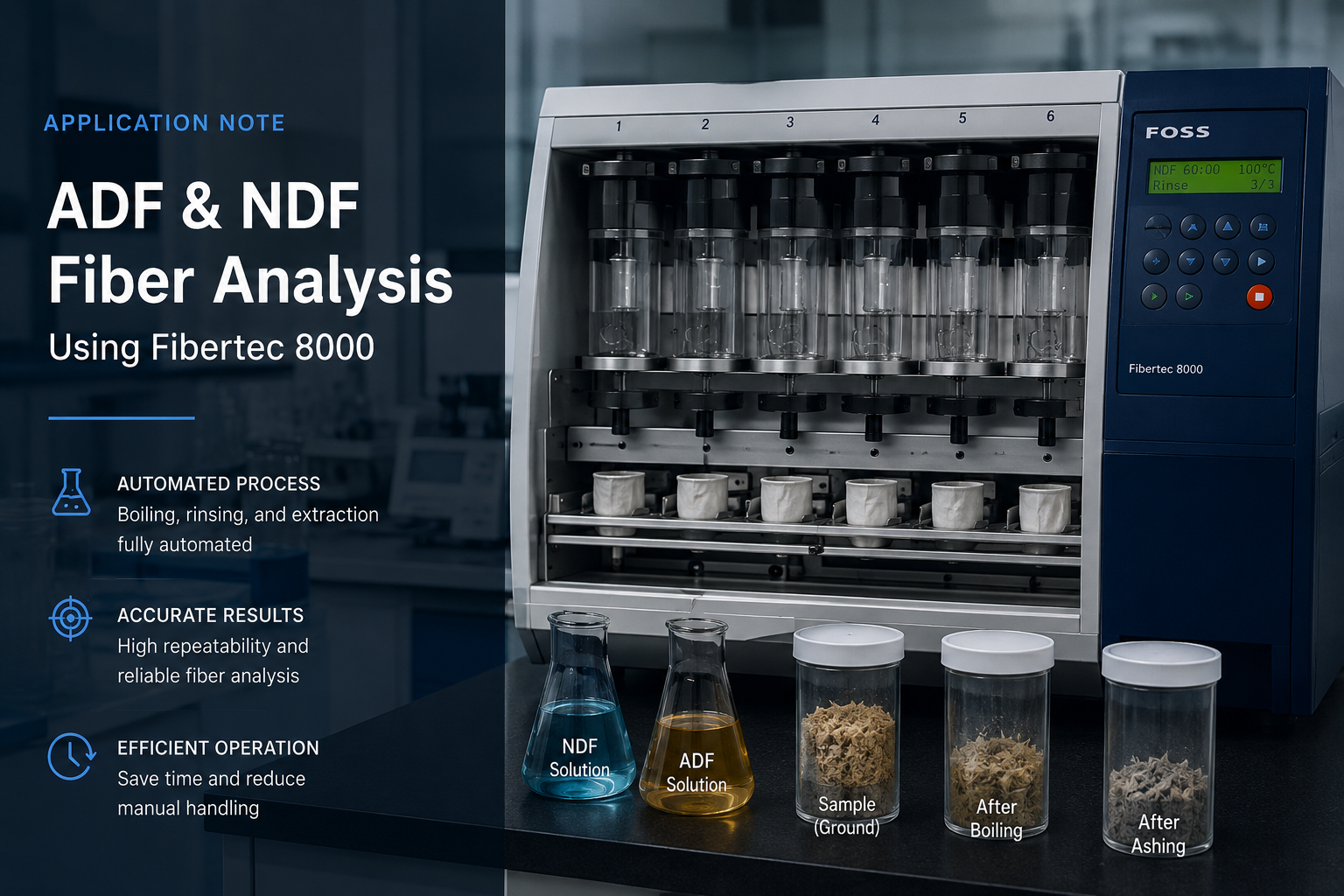
The Fibertec 8000 automates the boiling, rinsing, and extraction steps required for detergent fiber analysis, helping laboratories improve repeatability and reduce manual handling.
Principle of Fiber Analysis
Fiber analysis separates specific structural components from feed materials.
NDF Measures
- Hemicellulose
- Cellulose
- Lignin
NDF is commonly associated with:
- Feed intake
- Bulkiness
- Rumen fill
ADF Measures
- Cellulose
- Lignin
ADF is often related to:
- Digestibility
- Energy availability
Higher ADF values usually indicate lower digestibility.
Typical Workflow
1. Sample Preparation
Samples should be:
- Uniformly ground
- Dry
- Properly mixed
Typical particle size:
- 1 mm grinding recommended
Accurate grinding is critical for repeatable filtration performance.
2. Sample Weighing
Typical sample weight:
| Sample Type | Typical Weight |
|---|---|
| Feed | 0.5–1.0 g |
| Forage | 0.5 g |
| High-fat materials | Smaller weights recommended |
Samples are placed into Fibertec filter crucibles before analysis.
3. Reagent Addition and Boiling
The Fibertec 8000 automatically controls:
- Reagent filling
- Heating
- Boiling time
- Rinsing cycles
Typical Conditions for NDF
| Parameter | Example |
|---|---|
| NDF Solution | Neutral detergent |
| Boiling Time | 60 min |
| Heater Power | 90–100% |
Typical Conditions for ADF
| Parameter | Example |
|---|---|
| ADF Solution | Acid detergent |
| Boiling Time | 60 min |
| Heater Power | 90–100% |
4. Rinsing and Extraction
After boiling:
- Samples are rinsed thoroughly
- Residual detergent is removed
- Acetone extraction helps drying efficiency
Proper rinsing is essential for stable results.
Insufficient rinsing may cause:
- High residue weight
- Poor repeatability
- Increased blank values
5. Drying and Ashing
Typical procedure:
| Step | Condition |
|---|---|
| Drying | 105°C |
| Ashing | 525°C |
Drying removes moisture while ashing removes mineral residue.
Final fiber percentage is calculated from residue weight differences.
Basic Fiber Calculation
ADF or NDF results are generally calculated as:
Fiber(%)=Sample WeightResidue Weight−Blank×100
Accurate blank correction is very important for reliable data.
Common Troubleshooting Points
Weak Pressure During Discharge
Possible causes:
- Air leaks
- Trap contamination
- Weak pressure pump
- Valve leakage
Slow Filtration
Possible causes:
- Fine sample particles
- Overloaded crucibles
- Dirty filters
- Foam contamination
Overflow During Reagent Filling
Possible causes:
- Incorrect calibration
- Pump instability
- Sensor problems
- Blocked tubing
Poor Repeatability
Possible causes:
- Inconsistent grinding
- Incomplete rinsing
- Residual detergent
- Uneven drying
Good Laboratory Practices
For stable long-term operation:
- Clean crucibles immediately after use
- Inspect tubing regularly
- Monitor pressure and vacuum performance
- Replace worn silicone tubes
- Perform routine pump calibration checks
Preventive maintenance is essential for stable fiber analysis performance.
Final Thoughts
ADF and NDF analysis remain critical tools for evaluating feed quality and digestibility.
With the Fibertec 8000, laboratories can achieve:
- Improved automation
- Better repeatability
- Reduced operator workload
- Stable routine performance
Proper sample preparation and preventive maintenance remain the keys to reliable fiber analysis.