
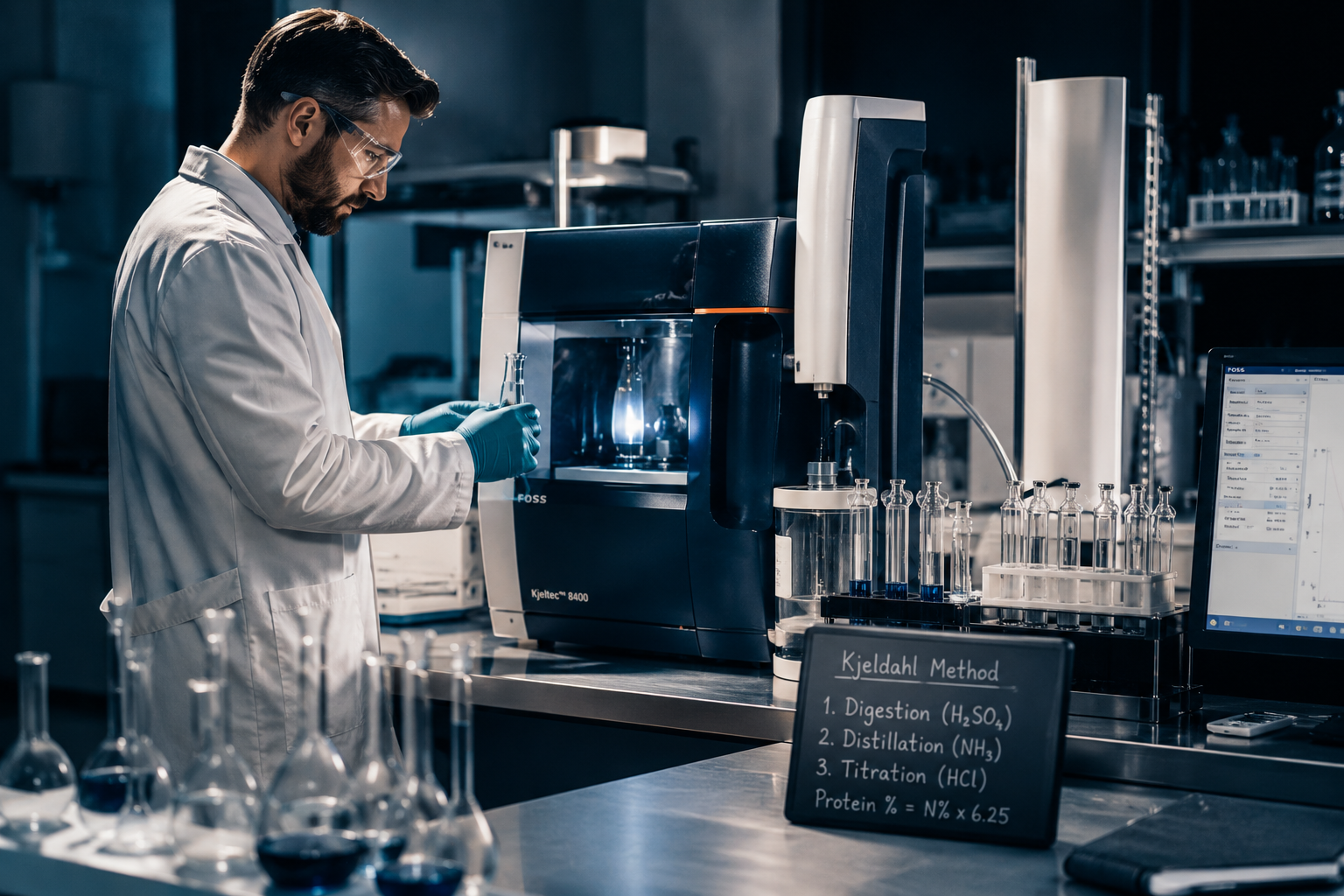
The Kjeldahl method remains one of the most trusted laboratory techniques for determining crude protein content in food, feed, and agricultural products.
With the Kjeltec 8400, laboratories can automate the distillation and titration process while improving repeatability and reducing operator workload.
This application note summarizes a common crude protein workflow used in routine laboratories.
Principle of the Kjeldahl Method
The Kjeldahl method measures total nitrogen in a sample.
The process consists of three major steps:
- Digestion
- Distillation
- Titration and calculation
The measured nitrogen is converted into crude protein using a conversion factor.
Most feed and food applications use:
Protein(%)=Nitrogen(%)×6.25
Typical Workflow
1. Sample Preparation
- Grind sample uniformly
- Mix thoroughly
- Weigh accurately into digestion tubes
Typical sample weights:
- Feed: 0.5–1.0 g
- Grain: 0.5 g
- High protein samples: smaller weights recommended
Consistency during weighing is extremely important for repeatability.
2. Digestion
Samples are digested using sulfuric acid and catalyst tablets.
Typical Digestion Conditions
| Parameter | Example |
|---|---|
| Sulfuric Acid | 12–15 mL |
| Catalyst | Kjeltabs |
| Temperature | 420°C |
| Time | 45–90 min |
The digestion continues until the solution becomes clear green or transparent.
Incomplete digestion may cause:
- Low recovery
- Poor repeatability
- High blank values
3. Distillation with Kjeltec 8400
After digestion:
- Tubes are transferred to the Kjeltec system
- Sodium hydroxide is automatically added
- Steam distillation releases ammonia
- Ammonia is collected into boric acid solution
The Kjeltec 8400 automates:
- Steam generation
- Alkali addition
- Distillation timing
- Receiver handling
- Titration
This greatly reduces operator variability compared to manual Kjeldahl systems.
Example Distillation Parameters
| Parameter | Typical Setting |
|---|---|
| Distillation Time | 4–6 min |
| NaOH Volume | Automatic |
| Steam Output | 70–100% |
| Receiver Solution | Boric acid + indicator |
Higher steam settings may reduce analysis time, but excessive steam can sometimes cause splashing or unstable recovery.
Titration and Calculation
After distillation, the collected ammonia is titrated using standardized acid.
The nitrogen content is calculated from acid consumption.
Basic nitrogen calculation:
Nitrogen(%)=Sample Weight (mg)(Vsample−Vblank)×N×14.007×100
Where:
- Vsample = sample titration volume
- Vblank = blank titration volume
- N = acid normality
Common Sources of Error
Low Recovery
Possible causes:
- Incomplete digestion
- Steam leakage
- Incorrect NaOH addition
- Condensation issues
- Old reagents
High Blank Values
Possible causes:
- Contaminated water
- Dirty tubes
- Reagent contamination
- Improper cleaning
Poor Repeatability
Possible causes:
- Inconsistent sample grinding
- Uneven weighing
- Digestion temperature variation
- Foam or bumping during digestion
Recommended Quality Checks
Routine laboratories should regularly verify:
- Blank recovery
- Ammonium sulfate recovery
- Distillation efficiency
- Steam leakage inspection
- Titrant standardization
A well-maintained Kjeldahl system can easily achieve excellent repeatability for routine crude protein analysis.
Final Thoughts
The Kjeldahl method remains the global reference technique for crude protein determination.
When combined with automated systems like the Kjeltec 8400, laboratories can achieve:
- High accuracy
- Improved safety
- Better reproducibility
- Reduced manual handling
Proper digestion quality and preventive maintenance are still the keys to reliable results.