
The Dumas combustion method has become one of the fastest and safest techniques for total nitrogen and crude protein analysis in modern laboratories.
Compared to traditional wet chemistry methods, the Dumas method offers:
- Rapid analysis
- No hazardous acid digestion
- High automation
- Excellent repeatability
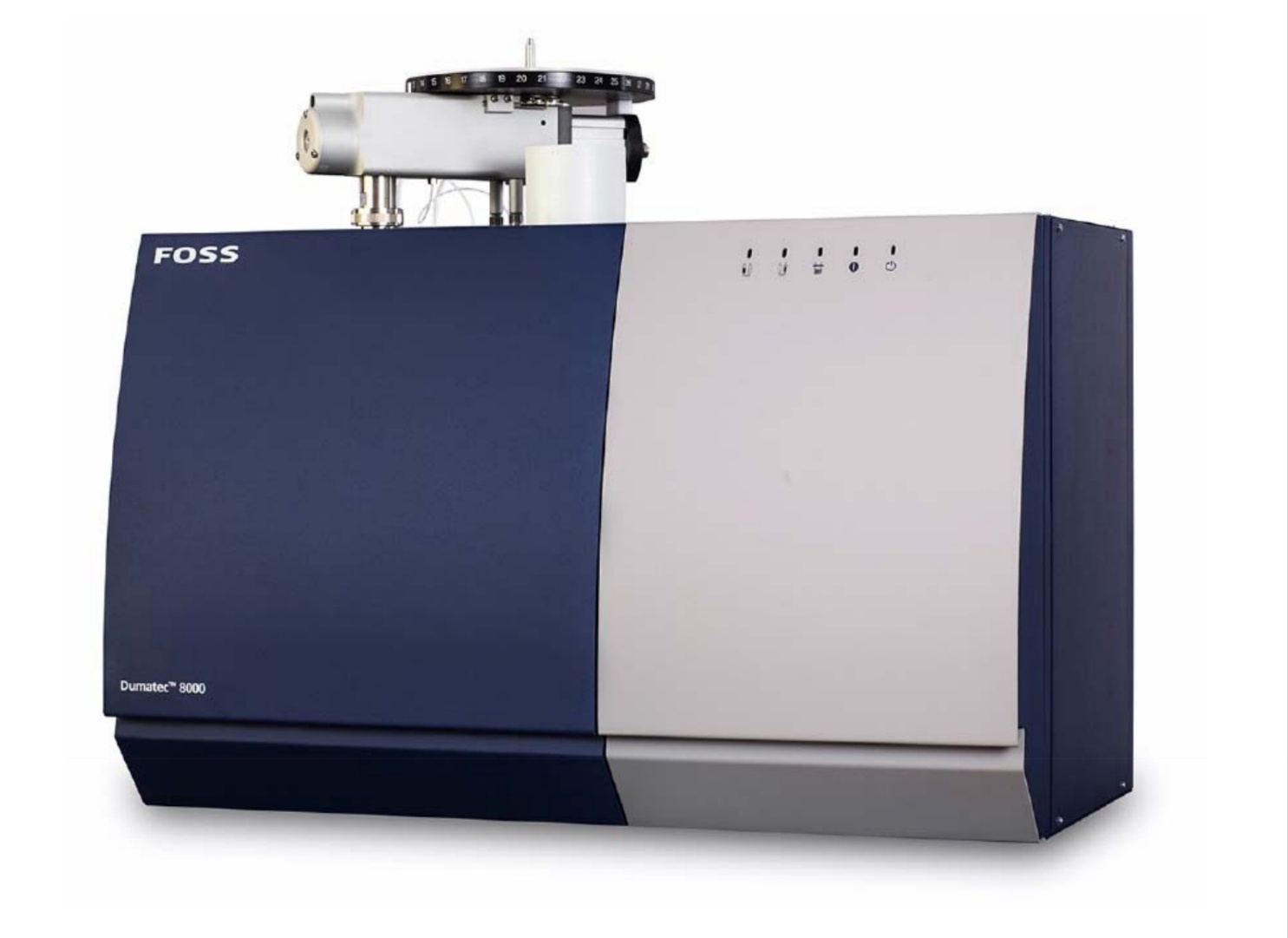
The Dumatec 8000 is widely used in feed, food, grain, dairy, and industrial laboratories for routine nitrogen determination.
Principle of the Dumas Method
The Dumas method determines nitrogen by combusting the sample at high temperature in an oxygen-rich environment.
The process includes:
- Combustion
- Reduction
- Gas separation
- Nitrogen detection
Nitrogen compounds inside the sample are converted into nitrogen gas and measured using a thermal conductivity detector (TCD).
Typical Workflow
1. Sample Preparation
Samples should be:
- Homogeneous
- Finely ground
- Properly mixed
Typical sample weight:
- Feed and grain: 150–300 mg
- High nitrogen samples: lower weights recommended
Uniform sample preparation is critical for stable peak areas.
2. Combustion
The sample is dropped into the combustion furnace under oxygen flow.
Typical combustion temperature:
950°C−1050°C
Inside the furnace:
- Organic material burns rapidly
- Nitrogen converts to NOx gases
- Excess oxygen ensures complete combustion
Incomplete combustion may cause:
- Low recovery
- Small peak areas
- Poor repeatability
3. Reduction and Gas Separation
After combustion:
- NOx gases pass through the reduction furnace
- Nitrogen oxides convert into N₂ gas
- Water and CO₂ are removed
- Pure nitrogen reaches the detector
Helium is typically used as the carrier gas.
Stable gas flow is essential for accurate peak stability.
Detection Principle
Nitrogen is measured using a Thermal Conductivity Detector (TCD).
The detector response is proportional to nitrogen concentration.
Basic nitrogen calculation:
Nitrogen(%)=Sample Weight(Asample−Ablank)×F
Where:
- Asample = sample peak area
- Ablank = blank peak area
- F = calibration factor
Crude protein is then calculated using the protein conversion factor.
Most feed applications use:
Protein(%)=Nitrogen(%)×6.25
Typical Instrument Conditions
| Parameter | Typical Setting |
|---|---|
| Combustion Temperature | 950–1050°C |
| Reduction Temperature | 600–650°C |
| Oxygen Flow | 200–250 mL/min |
| Carrier Gas | Helium |
| Analysis Time | 3–5 min |
The Dumas method is significantly faster than traditional Kjeldahl analysis.
Advantages of the Dumas Method
Fast Analysis
Most samples finish within a few minutes.
No Corrosive Acid Digestion
No sulfuric acid or alkali handling required.
This improves:
- Operator safety
- Laboratory cleanliness
- Maintenance workload
High Automation
The Dumatec 8000 automatically controls:
- Sample introduction
- Oxygen dosing
- Gas flow
- Detection
- Calculation
Excellent Repeatability
Proper calibration and stable gas flow provide highly reproducible results.
Common Troubleshooting Points
Low Peak Area
Possible causes:
- Incomplete combustion
- Oxygen leakage
- Furnace problems
- Worn crucibles
- Dirty reduction tubes
High Blank Values
Possible causes:
- Gas contamination
- Moisture leaks
- Dirty autosampler
- Contaminated tin foil
Unstable Calibration
Possible causes:
- Incorrect blank handling
- Poor standard weighing
- Gas flow instability
- Furnace contamination
Good Laboratory Practices
For stable long-term operation:
- Replace crucibles regularly
- Perform routine leak tests
- Monitor oxygen purity
- Clean ash buildup frequently
- Verify calibration daily
Preventive maintenance is extremely important for stable Dumas performance.
Final Thoughts
The Dumas combustion method is now one of the preferred techniques for routine nitrogen analysis in high-throughput laboratories.
With the Dumatec 8000, laboratories can achieve:
- Fast turnaround time
- High analytical accuracy
- Reduced chemical handling
- Excellent automation efficiency
For modern laboratories focused on productivity and safety, Dumas analysis offers major advantages over traditional wet chemistry methods.